
MINDFUL MONEY / ROUTINES
7 Bank Accounts to Organize Your Money
A simple way to organize your money — and make everyday finances feel easier.
BY CHOOSE HAPPY · 7 MIN READ

Managing your money doesn’t have to mean complicated spreadsheets or strict budgets.
One simple way to get a better overview is to give your money different places to go — for bills, everyday spending, savings, emergencies and the things you enjoy.
This makes it much easier to see:
What can I actually spend?
What needs to stay untouched?
How much am I saving?
You don’t need all seven accounts. Think of these as ideas for creating a simple system that works for you.
Before You Start
There is no perfect way to organize your money. Maybe you need all seven accounts. Maybe three is enough.
Do what works for you.
Before opening new accounts, check what your bank offers. Some banks let you create multiple accounts or savings pots for free, while others may charge fees or have limits.
The goal is to make managing your money simpler — not more expensive or complicated.
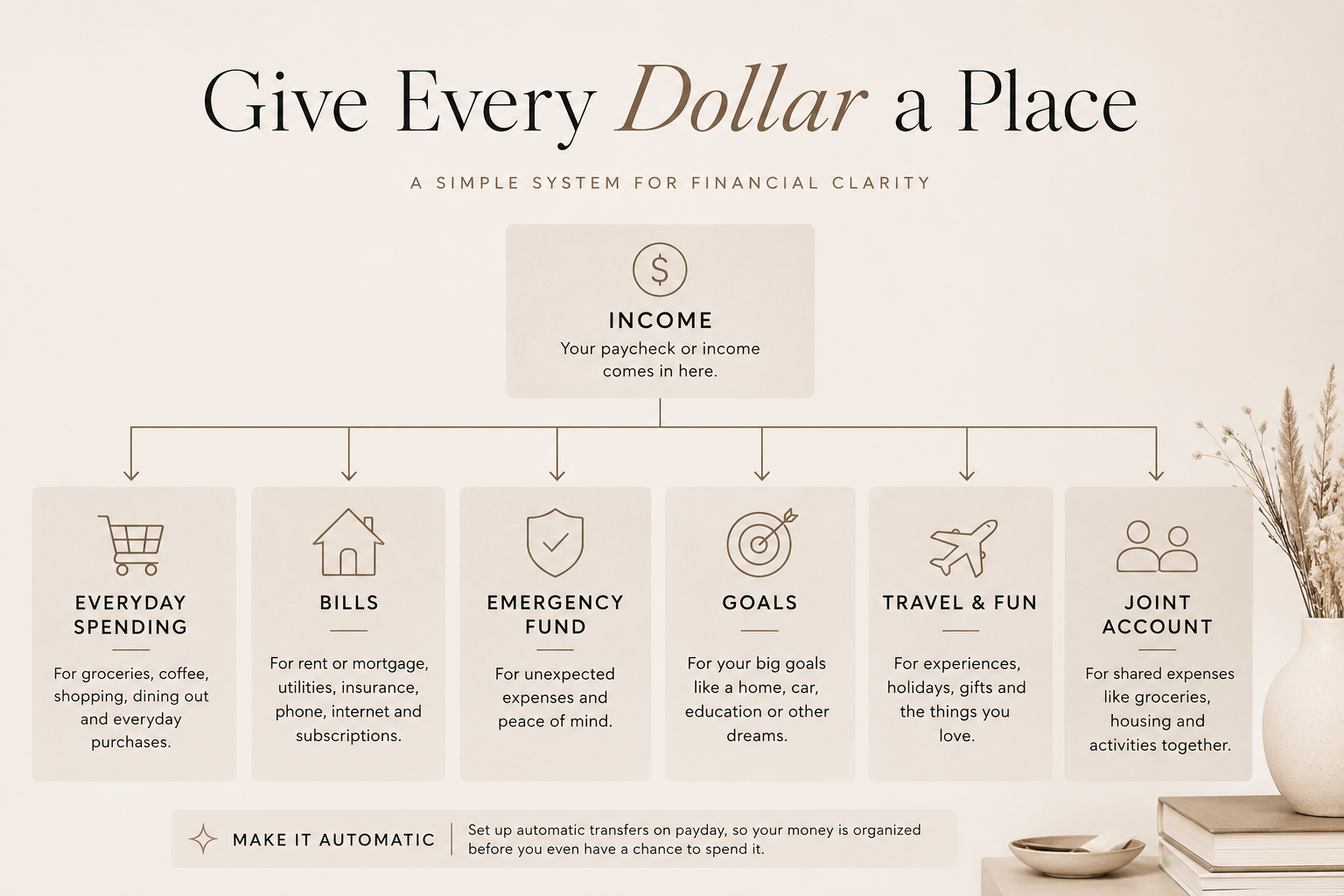
1. Income Account
Think of this as the starting point for your money. Your salary or other regular income comes in here before being distributed to your other accounts.
On payday, set up automatic transfers to your bills, spending, savings and emergency accounts. This way, your money gets organized before you even have the chance to spend it.
Quick tip: You don’t necessarily need a debit card connected to this account. Keeping your income separate from everyday spending makes it easier to see what you actually have available.
2. Everyday Spending Account
This is your “I can actually spend this” account.
Use it for everyday expenses like groceries, coffee, eating out, shopping and social activities.
Once your bills and savings are taken care of, transfer your spending budget here. That way, the balance you see is much closer to what you actually have available to spend.
A Simple Rule
If the money isn’t in your spending account, it isn’t available to spend.
This makes it easier to stay within your budget without constantly calculating what needs to be saved for later.
3. Bills Account
This account is for your regular bills and essential expenses — things like rent or mortgage, electricity, insurance, phone, internet and subscriptions.
Work out roughly how much you need each month and transfer that amount to your bills account on payday.
It’s also a good idea to leave a little extra in the account for bills that may vary from month to month.
The money in this account already has a job — so you don’t have to worry about accidentally spending it.
4. Goal Savings Account

This account is for the big things you’re working towards — like a home, wedding, car, education or another long-term goal.
Unlike your emergency fund, this money has a specific goal attached to it.
Make Your Savings Work for You
While you’re saving, let your money work for you too.
Look for a savings account with a competitive interest rate, no unnecessary fees and withdrawal terms that suit your goal.
If you want access to your money whenever you need it, look for an account that allows free withdrawals.
And remember: you don’t need to save huge amounts for it to count.
Small amounts add up when you give them enough time.
5. Emergency Fund
Your emergency fund is for the things you didn’t plan for — like a broken washing machine, an unexpected car repair, urgent travel or a sudden loss of income.
A common long-term goal is to have enough to cover around 3–6 months of essential expenses. But don’t let that number overwhelm you.
If you’re starting from zero, start smaller.
First goal: €500.
Then €1,000.
Then one month of essential expenses.
Build from there, at your own pace.
For your emergency fund, look for a savings account with a good interest rate and easy access to your money. Check for withdrawal limits or fees — emergency savings should be there when you actually need them.
Your emergency fund should grow while you don’t need it — and be there when you do.
YOUR EMERGENCY FUND CHECK
✓ Good interest rate
✓ Easy access
✓ Free or suitable withdrawals
✓ Separate from everyday spending
✓ Automatic monthly transfer
6. Travel, Fun or Wishlist Account

Not everything you save for has to be serious.
Having money set aside for the things you actually enjoy can make managing your finances feel a lot less restrictive.
Use this account for anything you’re looking forward to — like travel, concerts, Christmas, clothes, a new phone or that dream purchase.
Even a small automatic transfer each month can slowly build into something exciting.
And remember:
A broken washing machine is an emergency.
A trip to Italy isn’t.
Keeping these savings separate means you can enjoy the things you’ve planned for without dipping into your emergency fund.
7. Joint Account
If you share expenses with a partner, a joint account can make everyday finances much easier.
Use it for the things you share — like groceries, housing costs, household purchases and activities together. You can contribute 50/50 or choose a split that makes sense for your incomes and situation.
But sharing expenses doesn’t mean you have to combine everything.
It’s still a good idea for both people to have their own account and savings they can access independently. This isn’t about expecting something to go wrong — it’s simply about making sure both people maintain some financial independence.
Before using a joint account, check how your bank handles ownership and access rights, as this can vary between banks and countries.
Share your expenses without giving up your financial independence.
Make It Automatic
The easiest way to make this system work? Automate it.
Set up automatic transfers for payday so your money moves to the right accounts without you having to think about it every month.
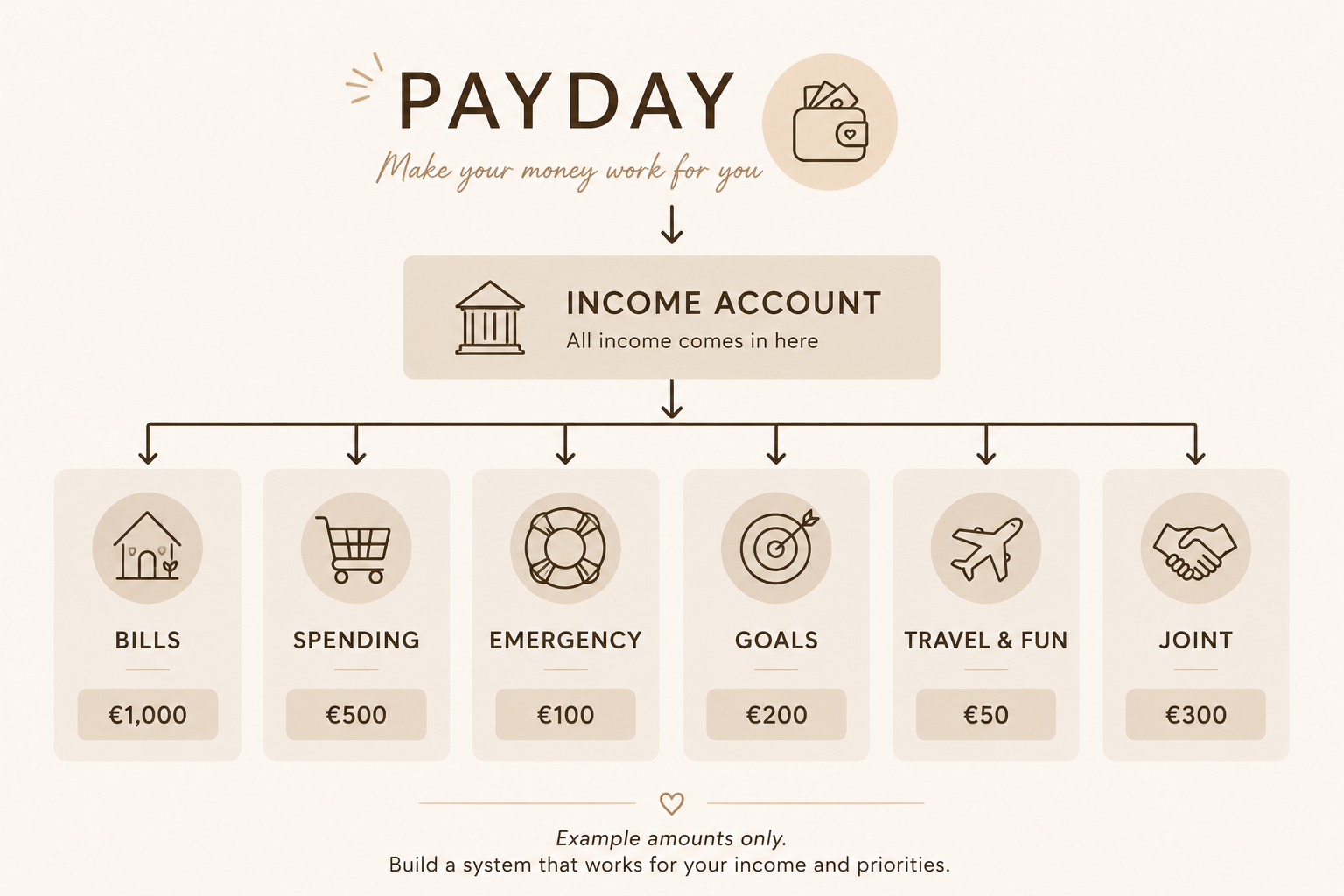
Once it’s set up, your money starts organizing itself:
Bills are covered.
Savings happen automatically.
Your emergency fund keeps growing.
And you know what you can actually spend.
Less to think about. More control over where your money goes.
You Don’t Need to Set Up Everything Today
If all your money is currently sitting in one account, you don’t need to change everything at once.
Start small.
Maybe your first step is opening a separate bills account. Then add a savings account when you’re ready.
You don’t get extra points for having seven accounts.
The goal isn’t to have more accounts — it’s to make your money easier to manage.
Find a system that works for you, and build from there.